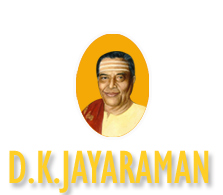
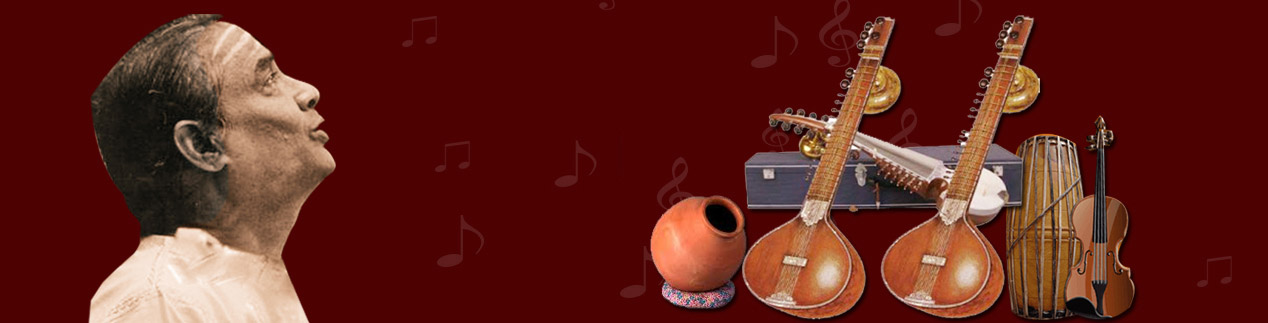
It is a peaceful evening. The venue, Sriman Srinivasa Road, Alwarpet, away from din of the maddening traffic, 20 students are singing Kamalambam Bhajare in unison, with zest. Their Guru, bare chested and sporting a lungi squats on the sofa, listening intently. Someone makes a mistake. He corrects it. By association of ideas, a joke comes to his mind. He narrates with relish, joining in the laughter with an infectious chortle. Then it’s back to work. Serious work. For the guru is a taskmaster, the perfectionist D.K.Jayaraman.
In 1928,when a sixth child was born to them on July 22nd little did Damal Krishnaswamy Dikshitar and Rajammal guess that this would be second Sangeetha Kalanidhi in the family. Jayaraman got his name as a thanksgiving by his mother to the deity in the nearby Theradi Anjaneya temple in Kanchipuram – a sixth female child would have been an inauspicious omen. His very beginnings promised a musical future. Pattammal was of course there. His father, himself a school teacher, could render Thevarams, Thirupugazh, Thiruppavai. Kavadichindu, Mooka Panchashati and other Sanskrit slokas fluently. It was from him that DKJ inherited his perfect diction, interest and aptitude for Tamil songs.
DKJ was keen on studies and put his foot firmly down when asked by his father to concentrate solely on music.
DKJ’s first formal guru was his own sister Sangeetha Kalanidhi D.K. Pattammal to whom, he declares, he owes everything. But having a keen mind, he absorbed a lot by just listening to Vidwans like Ambi Dikshitar, N.S. Krishnaswamy Iyengar ( disciple of Naina Pillai) Koteeswara Iyer, Flute Venkatarama Iyer, T. L. Venkatrama Iyer and Papanasam Sivan, when they came home to coach Pattammal. DKJ was perpetually thirsty for knowledge. He once pestered DKP to write down the words of Balagopala kriti for him. Where other children cherished their wooden toys or rocking horses, DKJ’s prized possession was that bit of paper containing the great piece. He mastered the kriti over night and rendered it perfectly the next day to an astonished but appreciative DKP. Small wonder then, that DKP fostered her younger brother‘s musical talent right from a tender age.
At the age of nine, he sang his first public concert in vocal support to his sister. The two hit it off superbly, the blend of their voices; their understanding and coordination were so perfect that DKP and DKJ became inseparable. The duo performed at the Music Academy in 1938 where DKJ stole the show causing Kalki to predict a great future for the boy (how true his words were). They sang the second inaugural concert at the A.I.R. in 1939 when the wireless radio was first launched in Madras. A year later they cut a disc. The songs “Gokulam Yamunai” and “Sri Muruganai” became instant hits. “Desa Sevai Seiyya Vareer” in Thyaga Bhoomi was on everybody’s lips during the pre Independence era.
Imagine a mere boy of 12 imparting musical knowledge to students. At an age where children have to be forced to even listen to music, DKJ had begun a career in music teaching. His first student was Sekhar, an auditor. At Kanchipuram, he would cycle through 9 villages to and from his tuition classes, practicing a Varnam or Kriti all the way, marking time on his handlebar. He thus earned the title “cycle vidwan” from the passersby, the first in his innumerable collection. Today DKJ has a battalion of students all over India and abroad. His relationship with his students has a special flavour. Says Vijay Siva, one of his old time students and a high class performer himself, “whenever he came to know I was indisposed, he would call up regularly, even personally to enquire about my health. During my concert for the Music Academy in 1984, my phone kept ringing to receive last minute tips from him. I later came to know that he had a very disturbed sleep the previous night and that such tension he had not mounted on him even for his own concert”.
DKJ’s first solo performance at the All India Radio in 1940 earned him a fee of Rs.45, a substantial amount those days. When DKJ sang at the Music Academy alone for the first time in 1951, he was lauded by Chembai Vaidyanatha Bhagavathar for handling the Todi Varnam deftly in three speeds. DKJ confided later that he was quite nervous that day especially with his sister in the audience right in front of him. Though he had no real stage fright, the Music Academy has always instilled in him a feeling of awe. After a long gap, came two concerts in 1957 and 58. But it was from 1962 that DKJ became a regular feature at the Academy. There was no looking back from there. To his credit, he has performed at all the venues of the Music Academy.
Meanwhile DKJ got married to Jaya and considered himself lucky in this respect. It was an arranged marriage, a simple function at the Tiruneermalai temple. Three children were born, Srivatsan, Sukanya and Vaidyanathan.
It was when Vaithi became seriously ill that the family shifted to Madras and set up a small house at Mylapore. This illness was a blessing in disguise. For DKJ was now in Madras, in the heart of Karnatic music and close to his sister and guru. The Kalaimamani from the Tamilnadu Govt., the Sur Singar Award (Bombay), the Sangeetha Choodamani (Krishna Gana Sabha), the Sangeeth Natak Academy Awards, the title of Gambhirgana mani from the Sankaracharya, that of Nada Jyoti from Papanasam Sivan, a certificate of appreciation from the Carnatic Music Association of North America for bringing joy to hundreds of listeners in the US and Canada.
Even Acharya Jayendra Saraswathi called him Paatu Jayaraman saying that he had a special affinity for DKJ’s music. But the most cherished among his titles is his very first one. Rajarathnam Pillai, the nadaswara Vidwan was DKJ’s hero in his youth. Often had the young Jayaraman listened to the maestro, wistfully wondering whether he himself would ever scale such heights. In 1938, at a wedding, DKP and DKJ sang Marubalka. Pillai was so impressed by DKJ’s music that he conferred on him the title Isai Thambi and gave him a shawl. Being lauded by one’s hero – what more than one could ask for?
DKJ soon became busy and moved into his own bungalow in Alwarpet. His concert tours multiplied. Every nook and corner of India was visited. Soon the cycle vidwan from the nondescript village of Vengudi was travelling abroad. He visited France, Germany, the USA, participated in the autumn festival in Paris and several festivals in India. He has recalled with amusement an incident n Kerala when his fee of Rs.1000/- was given entirely in 10 paisa coins. He remembers the tight schedules in the US, often heading straight for the concert halls from the airport for a 3 hour performance.
What makes DKJ tick. How does his music induce spontaneous appreciation? The beauty of his music lies in its appeal to the layman and the connoisseur alike. Be it an intricate pallavi or an old film hit of Sivan’s DKJ is equally at ease. A rasika gets the feeling of having had a full 4 course dinner after a DKJ concert. His forte is, of course, his unparalleled repertoire, his laya gnanam and the bhava with which his music is charged. Says James S Rubin, an American fan of his : “ I sometimes hear it in my mind”. There are people who have broken down and wept on hearing his maname kanamum, nannu vidachi or poonkuil. Even Lalgudi had moist eyes at the end of manathirkuganthathu rendering. His music shows evident of his willingness to accept all forms. At Loyola College, he had even tuned Psalms and Hymns for the Principal Father Jerome D’ Souza. Many a time has Lalgudi said that DKJ embellishes compositions and gives them his stamp. Gangadeeswaram and Karunai Deivame immediately conjure up the name DKJ.
DKJ maintained excellent rapport with his accompanists, encouraging them spontaneously. Once in Bangalore when Palghat Mani Iyer’s mridangam refused to come down to DKJ’s pitch. DKJ acquiesced to his request and sang at the higher pitch. That day’s concert was one of the most memorable, what with Mani Iyer’s exuberant support on one side and Lalgudi’s on the other.
What was DKJ the man like?
The image of DKJ as a musician, bringing hundreds under his spell is so strong that one often forgets that he was a human being with normal likes and dislikes. Indeed to the casual observer, a meeting with DKJ often created surprise. Often have people asked “could a great musician be so simple “Ask him his favourite dishes he says without hesitation “appalams and curd”. What does he do to take care of his throat? Nothing. Simply that. Even his daily wear – an old lungi spoke of his simplicity. His house perpetually crawled with visitors, students, their parents, secretaries and rasikas.There was no pompousness about this man. This simplicity was connected to a ‘joie de vivre’ that DKJ experienced in life. “Life is short, time is fleeting’ he has said on more than one occasion. Why not make the best of it. Santosha sakala bhava! Thus he enjoyed life at an age when most grumble about the good old days of yore. In Disney land, he enjoyed to the fullest the ghost chamber into which he entered despite being cautioned. Even more did he enjoy relating these experiences of ghosts that sat on his lap and cackled in his ear. DKJ had a zest for life – an enviable trait these days.
When DKJ was young, his day would begin at five, with cycle rounds for tuition before lunch, some rounds after and then practice sessions at night. This rigorous schedule he still followed throughout his life. All this interspersed with his performances on stage. Judge Tatachari of Chingelpet has compared DKJ to Henry Ford for his tireless work. He took upon himself the gigantic task of preparing 30 students for the presentation of Navavarana kritis. It had to be perfect. DKJ would sit for hours listening to tapes, mastering the intricacies of these heavy pieces. Duty is God, he says and his motto is now. His heroes were all workaholics or fervent believers in duty. Gandhi, Vivekananda, Buddha, Napoleon and even Hitler. His favourite anecdote is about Napoleon who while recruiting soldiers was supposed to have rejected thousands, selecting just the ones who agreed to start duty that very moment. Dr.Sunder, one of his senior disciples, and a workaholic himself, says that his masters work ethics inspired him throughout his life.
DKJ had other talents. His daughter Sukanya mentions that he had a flair for drawing. “Had not DKJ been such a good singer, he would have probably been a great artist. DKJ sketches true to life portraits with a simple lead pencil.
DKJ was also a cricket addict. A cricket match on TV meant a holiday from music class for a DKJ student. When young DKJ ran the Kanchipuram Cricket Association. He often recommended his students to sing the way Azharuddin bats – orthodox. His heroes. Bradman, Mushtaq Ali, Gavaskar and Viswanath.
He got his countless quotations and anecdotes from reading books, no doubt. He read through the life histories of Gandhi, Ramakrishna and Vivekananda and must have been influenced by them.
Today, several years after the passing away of the great man, we salute him for his music, his tireless work and the sincerity with which he taught so many of his disciples. His music lives on with us. Salutatio DKJ! - by Dr.Sunder M.D and Varalakshmi

